 Green Card Experts
 DE
 EN
 ES
 FR
 IT
 PL
 TR
 UA
Children Traveling Alone to the USA: Entry Requirements
When children fly to the USA alone, parents must consider both US entry requirements and the airline's rules. Minors may generally enter without a parent. However, they need their own travel documents and must be able to give a credible explanation of the purpose of their stay.
An ESTA authorization or US visa alone is not enough for the airline to carry the child. The airline may require an unaccompanied minor service, additional forms, and a specifically designated adult to meet the child. These requirements depend on the child's age, the route, and the airline.
- Entry clearance and air travel are assessed separately
- What documents do children traveling alone to the USA need?
- What should the parental consent letter include?
- What do border officials check upon arrival?
- What rules do airlines have?
- What rules apply to different citizenships?
- Traveling alone to stay with relatives or a host family
- What rules apply after selection in the Green Card Lottery?
- How can common mistakes be avoided?
- The airline determines the specific travel arrangements
- Frequently asked questions
- Sources
Take the chance of living in the USA and apply for the official US Green Card Lottery!
Key takeaways
- Every child needs a separate passport. Whether the child also needs an ESTA authorization or a US visa depends on citizenship and the purpose of travel.
- Since September 30, 2025, an ESTA has cost $40 per person and permits stays of no more than 90 days.
- A parental consent letter is not a general US entry requirement, but carrying one is recommended.
- Airlines often require an unaccompanied minor service and their own forms for children traveling alone.
- A child's passport that does not meet Visa Waiver Program requirements cannot be used for travel with ESTA.
Entry clearance and air travel are assessed separately
US authorities do not generally require a minor to travel with a parent. However, the airline decides under its own conditions whether it will carry the child and what requirements must be met.
As a result, two different age limits may apply. A child may meet the US entry requirements but still be refused carriage by the airline unless an unaccompanied minor service has been booked. For connecting itineraries in particular, the service must be confirmed with every airline involved.
The airline checks the documents at check-in. If the unaccompanied minor form, details of the designated adult, or a required consent document are missing, the airline may refuse carriage. Parents should therefore review the conditions before booking the flight rather than shortly before departure.
What documents do children traveling alone to the USA need?
Children traveling alone need their own valid passport and either a personal ESTA authorization or the appropriate US visa. They should also carry documents confirming parental consent, accommodation arrangements, and details of the adult meeting them.
The documents required for entry into the USA depend on the child's citizenship, purpose of travel, and passport type. Babies and young children also need their own travel documents. Being listed in a parent's passport is not sufficient.
The child should carry these documents in their hand luggage:
| Document | Purpose | Note |
|---|---|---|
| Electronic passport | Required for travel with ESTA | Must match the passport listed in the ESTA application |
| ESTA or US visa | Required separately for each child | Depends on the passport, purpose of travel, and length of stay |
| Parental consent letter | Documents the consent of the child's legal guardians | Ideally in English and the language of the child's home country |
| Birth certificate | Provides evidence of the parent-child relationship | Particularly useful if family names differ |
| Copies of the parents' passports | Help verify the signatures | Include clearly legible contact details |
| Airline form | Sets out supervision and handover arrangements | Mandatory for certain age groups |
| Travel and pickup details | Confirm accommodation and travel arrangements | Include flight numbers and the designated adult's phone number |
A separate passport for travel to the USA
To travel without a visa under the Visa Waiver Program, a child must have a separate electronic passport. The passport must contain a chip and be valid for the planned trip. The requirements for a passport for US travel apply whether the child flies alone or with their parents.
A child's passport that does not meet the ESTA requirements cannot be used for visa-free travel. If this is the child's only passport, the child needs a US visa. Parents should check the official travel guidance issued by the relevant authorities in their home country again before booking.
A separate ESTA for every eligible child
Every minor traveling under the Visa Waiver Program needs a separate ESTA authorization. This also applies to infants and to children whose applications are completed by a parent. A group application merely combines several individual applications and does not replace each traveler's personal authorization.
ESTA is part of the Visa Waiver Program for short visits without a visa. It allows eligible citizens of participating countries to travel for tourism or business, or to transit through the USA, for no more than 90 days. The list of participating countries must be checked for the child's citizenship before travel.
Since September 30, 2025, the official ESTA fee has been $40 per application. An approved authorization permits travel to a US port of entry but does not grant a right to admission. US border officials make the final decision upon arrival.
What should the parental consent letter include?
A consent letter for the child's trip should clearly document the approval of all legal guardians whose consent is required. It is not a general requirement for entry into the USA, but it can make checks by the airline and border authorities easier.
The U.S. Department of State recommends carrying additional evidence of the legal relationship between the parents and the child. This is particularly relevant when family names differ or only one parent has legal custody.
The letter should include:
- the child's full name and date of birth
- the child's passport number and citizenship
- the names, addresses, and contact details of the legal guardians
- the travel dates, flight numbers, and destination
- the address of the accommodation in the USA
- the name, address, and phone number of the designated adult meeting the child
- explicit consent for the child to travel alone
- the place, date, and signatures of the legal guardians
A bilingual version in English and the language of the child's home country can make follow-up questions easier to resolve. Copies of the signatories' identity documents should also be attached. If one person has sole legal custody, carrying evidence of this is advisable.
Notarization is not generally required for entry into the United States. However, it may be required by the airline, the country of departure, or a transit country. For an itinerary connecting through Canada, Canadian transit requirements must therefore also be considered.
What do border officials check upon arrival?
U.S. Customs and Border Protection checks the child's identity, entry documents, purpose of travel, length of stay, and accommodation. A child traveling alone may also be asked who will meet them and whether their parents have consented to the trip.
The child should be able to provide basic information independently, including the name of the designated adult, the destination address, and the reason for the trip. For younger children, a clearly labeled document folder containing all information in the same order can help.
At immigration inspection, unaccompanied minors are subject to the same basic ESTA or visa requirements as adults. However, officers pay particular attention to who is expecting the child and whether the travel arrangements are credible and clear.
The information in the consent letter, flight booking, and airline form should match. If a different person must meet the child at short notice, the airline must be informed in advance. Many airlines will release the child only to the registered individual named in their records after checking that person's identification.
What rules do airlines have?
Airlines often use the term unaccompanied minor, abbreviated as UM, for a child traveling alone. The unaccompanied minor service includes supervision at departure, during the flight, during permitted connections, and until the child is handed over to the registered person meeting them.
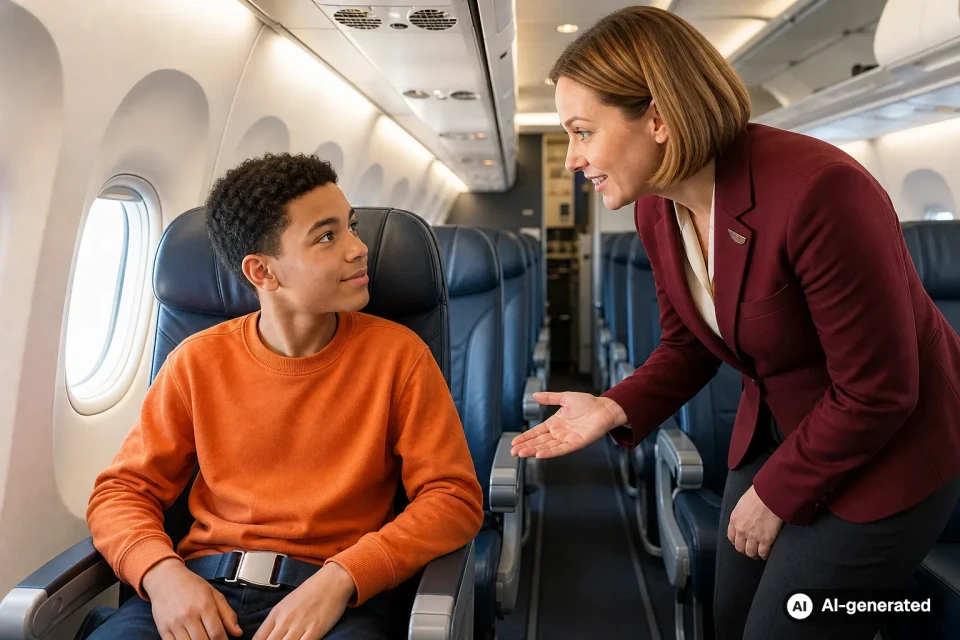
Age limits, fees, and booking requirements vary by airline. Policies reviewed as of November 4, 2026, should always be confirmed directly with the airline before booking.
Mandatory service for younger children
Many airlines require children ages 5 through 11 who are traveling alone to use their unaccompanied minor service. The child must usually be registered in advance, and younger children may not be permitted to travel without an eligible accompanying person.
The service may be charged per child and flight segment. Fees can differ between shorter flights and long-haul international routes, so an itinerary with a connection may incur more than one service fee in each direction.
Optional service for older minors
For travelers ages 12 through 17, the unaccompanied minor service may be optional, depending on the airline. Some carriers use a lower upper age limit, while others allow parents or guardians to request supervision until the traveler turns 18.
Airlines may also impose additional conditions or fees for connecting itineraries. Some bookings must be made through the airline's service center rather than online.
Registration and contact details
The service should be arranged directly with the airline well before departure. Some carriers no longer require registration as an unaccompanied minor from age 16, but their specific rules must still be checked before booking.
Airlines generally require the names and contact details of the people bringing the child to the departure airport and meeting the child on arrival. They may also request an emergency number that is available around the clock.
What rules apply to different citizenships?
The child's passport and citizenship determine the applicable entry requirements, not where the family lives. A residence permit issued by another country does not automatically make a passport eligible for ESTA.
Citizens of Visa Waiver Program countries
Children who are citizens of a Visa Waiver Program country may use the program if they have an eligible electronic passport. They also need their own valid ESTA authorization and must meet all other program requirements.
Additional documents may be required when the child leaves their country of residence or citizenship. Authorities in a transit country may also set their own requirements for minors. The parental consent letter should therefore list the entire itinerary, not only the U.S. destination.
Other and dual citizenships
Whether the child needs a U.S. visa depends on their citizenship and purpose of travel. This remains true even if the child permanently resides in another country. A residence permit does not replace ESTA eligibility. For citizens of countries outside the Visa Waiver Program, a B-2 visitor visa is generally required for a tourist visit.
For a child with dual citizenship, the family must determine which passport will be used for the trip. The ESTA authorization and flight booking must contain the same passport details. Special rules apply to U.S. citizens because they are generally required to enter the United States using a U.S. passport.
Traveling alone to stay with relatives or a host family
If the child is flying to stay with relatives or a host family, the parents should document the pickup arrangements particularly carefully. The contact person's name, address, and telephone number must match the information provided to the airline.

Many airlines require the person meeting the child to be an adult, present photo identification, and arrive at the airport on time. That person must remain in the arrivals area until the child has been formally handed over. If no one arrives, the airline will arrange further supervision or return transportation under its conditions of carriage.
For travel under ESTA, the accommodation, return flight, and length of stay should also be confirmed. A visit to relatives may last no more than 90 days. Attending school, taking up employment, or remaining permanently in the United States is not permitted under the Visa Waiver Program.
What rules apply after selection in the Green Card Lottery?
Entering the United States through an immigration process is fundamentally different from traveling under ESTA. Minor family members need their own passports, their own immigrant visas, and the application documents required for each individual.
After selection in the Green Card Lottery, eligible spouses and unmarried children may derive their immigrant visas from the principal applicant. Each person must submit a separate DS-260 online form. Required documents also include a birth certificate and passport, as well as a medical examination.
The principal applicant must enter the United States before or at the same time as derivative family members. A minor child therefore cannot enter first. If the child follows later, the immigrant visa must still be valid at the time of entry.
If the child travels alone after the immigrant visa has been activated, the airline's rules still apply. A consent letter from a parent or legal guardian who is not traveling may also be required. Individual legal advice may be appropriate in custody-related cases.
How can common mistakes be avoided?
Common problems arise from ineligible passports, missing individual applications, or inconsistent information. Parents should prepare a separate document folder for the child and compare all details before departure.
These mistakes occur particularly often:
- The child travels with a passport that does not meet Visa Waiver Program requirements and has an ESTA authorization instead of a visa.
- Only one ESTA authorization has been obtained for several family members.
- The mandatory unaccompanied minor service was not booked in time.
- The person meeting the child does not match the person named on the airline's form.
- The child's last name differs from the parent's, but the birth certificate or custody documents are missing.
- The entry or transit requirements of a connecting country were overlooked.
- The child does not know the destination address or the name of the person meeting them.
Parents should also store digital copies of all documents. The child still needs to carry the originals and any required printouts in their hand luggage. A dead phone battery or lack of internet access must not prevent access to essential contact information.
The airline determines the specific travel arrangements
Whether a child can fly alone depends on more than age. The child's independence, language skills, possible connections, and supervision at the destination also matter. A nonstop flight significantly reduces handovers and makes the trip easier to organize.
The person booking the trip should first confirm the airline's age requirements and then arrange the passport, ESTA authorization, or visa. This prevents a situation in which the child has valid entry documents but the airline still refuses to carry them.
Frequently asked questions
Can a child traveling alone take a connecting flight?
That depends on the airline and itinerary. Some airlines permit supervised connections only at certain airports or do not allow the child to take the final connecting flight of the day. The entire itinerary must be approved when the trip is booked.
Does the person meeting the child need written authorization?
The airline normally requires the person to be registered by name in advance and to present photo identification. Separate authorization may be required for medical decisions, depending on the applicable law.
Is travel medical insurance mandatory?
Travel medical insurance is not a general entry requirement for tourist travel under ESTA. However, because medical treatment in the United States can be very expensive, the child should have adequate coverage.
Can an older sibling act as the accompanying person?
This depends on the airline's definition of an eligible accompanying traveler. Not every airline considers a 16- or 17-year-old to be an adult accompanying person. The airline must expressly approve this arrangement before booking.
What happens if the flight is canceled?
A child booked into the unaccompanied minor service remains under the airline's supervision until permitted onward travel or a handover has been arranged. The designated emergency contact must remain available. The airline's unaccompanied minor terms specify the applicable rebooking and accommodation arrangements.
Sources